


Explore Jeep History, Capability & Adventure
Jeep traces its heritage to the rugged military 4×4 vehicles developed during World War II. From those early machines came a lasting identity built around capability, freedom, open-air driving, off-road exploration, and vehicles designed to travel beyond ordinary roads.
Explore the Jeep story from the Willys MB and first civilian CJ models to Wagoneer, Cherokee, Wrangler, Gladiator, modern SUVs, hybrid technology, electric vehicles, and available Jeep inventory at Sid Dillon.

The Birth of the Jeep 4×4
Jeep heritage begins with the U.S. Army’s search for a lightweight reconnaissance vehicle in 1940. Bantam, Willys-Overland, and Ford each contributed to the development process that produced the basic form of the military 4×4 that became known around the world as the jeep.
Willys-Overland developed the Quad prototype and later the Willys MB, which served Allied forces during World War II. Compact dimensions, four-wheel drive, simple construction, and exceptional mobility made the vehicle useful across a wide range of military applications.
Early Jeep Highlights
- U.S. Army requested a light reconnaissance vehicle in 1940
- Bantam, Willys, and Ford participated in early development
- Willys Quad helped establish the basic Jeep 4×4 formula
- Willys MB served extensively during World War II
- Capability and versatility became defining Jeep characteristics
From Battlefield to Civilian Life
After World War II, Willys adapted the military vehicle concept for farms, businesses, recreation, and civilian transportation. The CJ-2A arrived in 1945 and became the first widely marketed civilian Jeep vehicle.
The civilian lineup soon expanded beyond the traditional open-body 4×4. The Willys Wagon arrived in 1946, followed by additional trucks and utility vehicles that demonstrated how the Jeep formula could serve both work and everyday transportation.
Postwar Highlights
- CJ-2A introduced in 1945
- CJ stood for Civilian Jeep
- Willys Wagon expanded Jeep utility in 1946
- Jeep vehicles served farms, businesses, and outdoor recreation
- Civilian models preserved the capability of their military predecessors


Jeep Becomes an Adventure Icon
During the 1950s, Jeep vehicles increasingly moved beyond their military and agricultural roots into recreation and personal transportation. The CJ family continued evolving while maintaining the compact proportions and four-wheel-drive capability associated with the original design.
The CJ-5 became one of the most recognizable models of the era and remained in production for decades. Off-road events such as Jeep Jamborees also helped create a community around recreational four-wheel driving.
1950s Jeep Highlights
- CJ models continued evolving for civilian use
- CJ-5 became a long-running Jeep nameplate
- Recreational four-wheel driving grew in popularity
- Jeep Jamboree events helped build an enthusiast community
Wagoneer Expands the Meaning of a 4×4
Jeep expanded into a more comfortable and family-oriented form of four-wheel-drive transportation with Wagoneer during the 1960s. The vehicle combined rugged capability with passenger-car-inspired comfort and convenience.
The related Gladiator pickup demonstrated the flexibility of the platform by pairing Jeep four-wheel-drive capability with a pickup bed. These vehicles helped establish ideas that would later become fundamental to modern SUVs and lifestyle pickups.
Wagoneer Era Highlights
- Wagoneer blended four-wheel drive with family-oriented comfort
- Gladiator extended Jeep capability into a pickup format
- Automatic transmission and comfort features broadened 4×4 appeal
- Jeep increasingly combined utility with premium transportation


Cherokee, CJ-7 and a Growing SUV Legacy
Jeep continued expanding during the 1970s and 1980s with vehicles that served increasingly diverse customers. Cherokee developed into one of Jeep’s best-known SUV nameplates, while the CJ family remained closely connected to traditional open-body off-road driving.
The CJ-7 introduced a longer wheelbase and refinements that made the traditional Jeep formula more adaptable for recreational and everyday use. Meanwhile, later Cherokee generations helped demonstrate that an SUV could combine compact dimensions, passenger comfort, cargo flexibility, and serious four-wheel-drive capability.
Era Highlights
- Cherokee became a major Jeep SUV nameplate
- CJ-7 expanded the traditional CJ platform
- Comfort and everyday usability became increasingly important
- Jeep maintained a strong focus on four-wheel-drive capability
Wrangler Carries the Open-Air Jeep Tradition Forward
Wrangler arrived during the 1980s as the successor to the CJ series. It preserved recognizable Jeep elements such as removable tops, available removable doors, upright styling, and trail-focused four-wheel-drive hardware while increasing comfort and everyday usability.
Successive Wrangler generations have continued evolving suspension, safety, technology, powertrains, interior comfort, and off-road systems without abandoning the basic open-air adventure formula that connects Wrangler to early Jeep vehicles.
Wrangler Highlights
- Wrangler succeeded the CJ family
- Open-air driving remains a central design feature
- Solid axles continue to support serious off-road capability
- Multiple generations have added technology and refinement
- Trail Rated capability remains an important Wrangler identity


The Return of the Jeep Pickup
The modern Gladiator returned Jeep to the midsize pickup market while preserving many of the features enthusiasts associate with Wrangler. Its design combines an open-air cabin, four-wheel-drive capability, off-road hardware, and the utility of a pickup bed.
Gladiator demonstrates how Jeep’s traditional adventure-focused identity can extend into a truck without simply becoming a conventional pickup.
Gladiator Highlights
- Midsize pickup built around Jeep adventure capability
- Available removable roof and doors
- Pickup bed adds hauling versatility
- Trail-focused configurations support off-road driving
- Modern Gladiator continues a historic Jeep pickup tradition
The Modern Jeep Vehicle Family
Today’s Jeep lineup reaches far beyond the traditional two-door off-road vehicle. Compact SUVs, family vehicles, three-row models, premium full-size SUVs, pickups, hybrid technology, and battery-electric vehicles now sit alongside Wrangler.
Compass provides a compact SUV option, while Cherokee has returned with a hybrid powertrain. Grand Cherokee continues as a two-row or available three-row family SUV, Gladiator serves the midsize pickup market, and Grand Wagoneer occupies the premium full-size end of the lineup.
Modern Jeep Highlights
- Compass offers compact SUV versatility
- Cherokee combines SUV capability with hybrid technology
- Wrangler continues Jeep’s open-air off-road tradition
- Grand Cherokee offers two-row and three-row configurations
- Gladiator combines pickup utility with Jeep capability
- Grand Wagoneer serves the premium full-size SUV segment

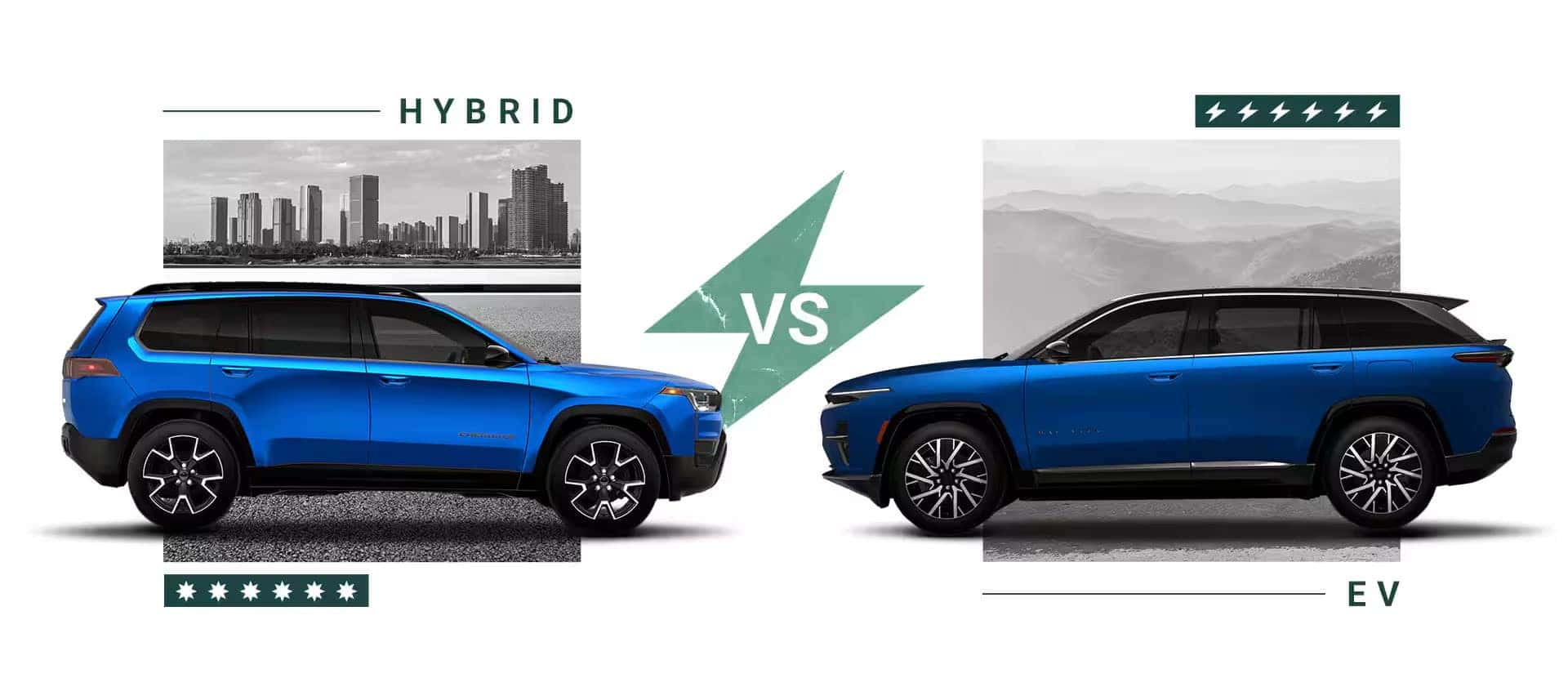
Hybrid and Electric Jeep Capability
Electrification has become another chapter in Jeep’s evolution. Earlier Wrangler 4xe and Grand Cherokee 4xe plug-in hybrids introduced many Jeep drivers to electrified four-wheel-drive vehicles and helped demonstrate how electric assistance could be integrated with traditional Jeep capability.
Jeep’s current direction now includes the hybrid Cherokee and dedicated battery-electric vehicles. Wagoneer S offers an electric SUV interpretation of Jeep design, while Recon brings fully electric propulsion to a vehicle developed around adventure and Trail Rated capability.
Electrified Jeep Highlights
- Earlier 4xe models helped introduce plug-in hybrid Jeep capability
- Current Cherokee uses a turbo hybrid powertrain
- Wagoneer S brings fully electric propulsion to the Jeep SUV family
- Recon is a fully electric, Trail Rated adventure SUV
- Multiple powertrain strategies now support Jeep’s future development
Browse Current Inventory
Explore our available selection and find the right fit for your needs. Inventory updates regularly, so check back often for the latest availability, trims, and options.
Contact Sid Dillon Jeep
Have questions about a Jeep SUV, Gladiator pickup, hybrid, or electric vehicle? Contact Sid Dillon and let our Jeep team help you explore available inventory, features, financing, and test-drive options.
Frequently Asked Questions
Where did the Jeep brand originate?
Jeep heritage traces back to lightweight four-wheel-drive military vehicles developed for the U.S. Army beginning in 1940. The Willys MB became one of the best-known military vehicles of World War II.
What was the first civilian Jeep vehicle?
The CJ-2A, introduced in 1945, was the first widely marketed civilian Jeep vehicle. It adapted the basic military Jeep formula for farming, industry, transportation, and recreational use.
What is Jeep Trail Rated?
Trail Rated identifies Jeep vehicles that meet Jeep Brand capability standards involving areas such as traction, water fording, maneuverability, articulation, and ground clearance. Availability varies by model and configuration.
What Jeep models are available today?
Jeep’s current vehicle family includes Compass, Cherokee, Wrangler, Grand Cherokee, Gladiator, Grand Wagoneer, Wagoneer S, and Recon. Availability can vary by dealership and production timing.
Does Jeep still make the Cherokee?
Yes. Cherokee has returned to the Jeep lineup with a hybrid powertrain, bringing the historic nameplate into a new generation.
Does Jeep still make the Wrangler 4xe and Grand Cherokee 4xe?
Jeep states that Wrangler 4xe and Grand Cherokee 4xe are no longer in production. Limited dealer inventory may still exist, and Jeep continues to provide support for current owners.
Does Jeep offer fully electric vehicles?
Yes. Jeep’s electric vehicle lineup includes Wagoneer S and the all-electric Recon. These models bring battery-electric propulsion into different parts of the Jeep SUV range.
What is the Jeep Recon?
Recon is a fully electric Jeep SUV developed around adventure and off-road capability. Jeep identifies Recon as a Trail Rated electric vehicle.
Is the Jeep Gladiator an SUV or a truck?
Gladiator is a midsize pickup truck. It combines a pickup bed with Jeep design characteristics such as available open-air features and trail-focused four-wheel-drive capability.
Where can I shop for Jeep vehicles at Sid Dillon?
Sid Dillon offers new Jeep vehicles through its dealership group and online inventory. Use the Jeep inventory link on this page to browse currently available models.
